
Research Spotlight: Mapping Chemoresistance in High-Grade Serous Ovarian Cancer
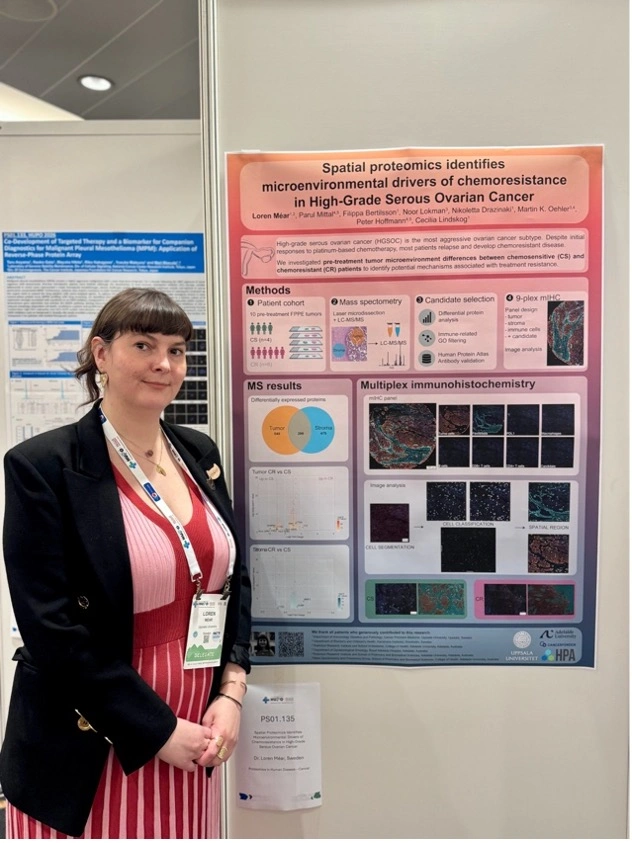
Could the tumor microenvironment help explain why some patients respond to chemotherapy while others develop resistance? At HUPO 2026 in Singapore, Loren Méar presented research combining mass spectrometry-based and antibody-based spatial proteomics to investigate potential markers of chemotherapy response in pretreatment tumor samples.
Méar, a postdoctoral researcher in Cecilia Lindskog’s group at Uppsala University, which is responsible for the Tissue Atlas resource within the Human Protein Atlas, is investigating how protein-expression patterns and the spatial organization of the tumour microenvironment may be associated with chemotherapy resistance.
Key study highlights
- Examining the tumor and its surroundings: The team analyzed pretreatment tissue from ten patients, four chemosensitive and six chemoresistant, combining MALDI mass spectrometry imaging, LC–MS/MS of microdissected tumor and stromal compartments, and multiplex immunohistochemistry.
- Selecting candidates for further investigation: Protein-expression analysis identified hundreds of differences between response groups. Filtering, informed by Human Protein Atlas antibody-validation data and immune-related annotations, narrowed the selection to 11 candidate proteins.
- Preserving spatial context: A nine-plex Opal™ antibody panel enabled the researchers to examine selected candidates alongside markers identifying tumor, stromal and immune components.
From protein discovery to antibody-based analysis
Antibody suitability was part of Méar’s selection process from the outset. Following the mass spectrometry analysis, she assessed candidates using antibody information from the Human Protein Atlas (HPA), alongside evidence linking the proteins to immune processes. This helped guide which targets to investigate within the tissue.
“We have developed a nine-plex multiplex antibody panel,” Méar explains. The panel includes markers for tumor cells, fibroblasts, PD-L1 and different immune cell populations, with an open channel for investigating selected candidate proteins.
“Our approach allows us to test any kind of candidate we want in an open channel,” she says.
Image analysis allows the team to examine where candidates are expressed and whether immune cells infiltrate the tumor region, connecting the protein-discovery results with the organization of the microenvironment.
Toward better patient stratification
The poster reports compartment-specific protein-expression patterns associated with treatment response, highlighting potential immune and stromal contributions to chemoresistance. In this small, exploratory cohort, the findings identify candidates for further investigation, with the longer-term goal of improving patient stratification and informing more tailored treatment strategies.
The research is conducted in collaboration with Professor Peter Hoffmann at Adelaide University in Australia and is supported by Cancerfonden.
Atlas Antibodies is proud to enable Loren Méar’s work with HPA antibodies, supporting her investigation of the tumor microenvironment and chemotherapy resistance in ovarian cancer.