
Overcoming the 4 Biggest Hurdles in Multiplex Immunohistochemistry (mIHC)
Multiplex Immunohistochemistry (mIHC) has become an essential method for unravelling the complexities of the tissue microenvironment. However, many researchers find themselves caught between two extremes: the significant cost of automated imaging systems and the frustratingly slow optimization of manual protocols.
The path to brilliant, multi-target visualization shouldn't require such a compromise. Below, we break down the four primary hurdles in manual multiplexing and introduce a more accessible path to reliable data.
Hurdle #1: Antibody Host Species Restrictions
The ability to build custom antibody panels is crucial for targeted research, but traditional methods often lead to a major roadblock: primary antibody host species restrictions.
If you attempt to use two primary antibodies raised in the same species (e.g., two mouse monoclonals) with standard secondary detection, the secondary antibody will bind to both. This makes it impossible to distinguish your targets and severely limits your choice of antibodies.
The Solution:
Look for detection technologies that are not dependent on secondary antibodies. By bypassing this step, you gain the freedom to build your panel with the best-performing antibodies for the job, regardless of host species.
The AtlasPlex Advantage: Our technology eliminates host dependency, allowing you to choose from over 12,000 Human Protein Atlas antibodies to create your 3-plex and 5-plex panels quickly.
Hurdle #2: The Signal vs. Noise Dilemma
A successful multiplex experiment depends on a strong, specific signal with minimal background. Inefficient detection methods or inconsistent biotinylation often result in weak signals that are difficult to distinguish from autofluorescence. Furthermore, photobleaching can cause your signal to fade during long, high-resolution imaging sessions.
The Solution:
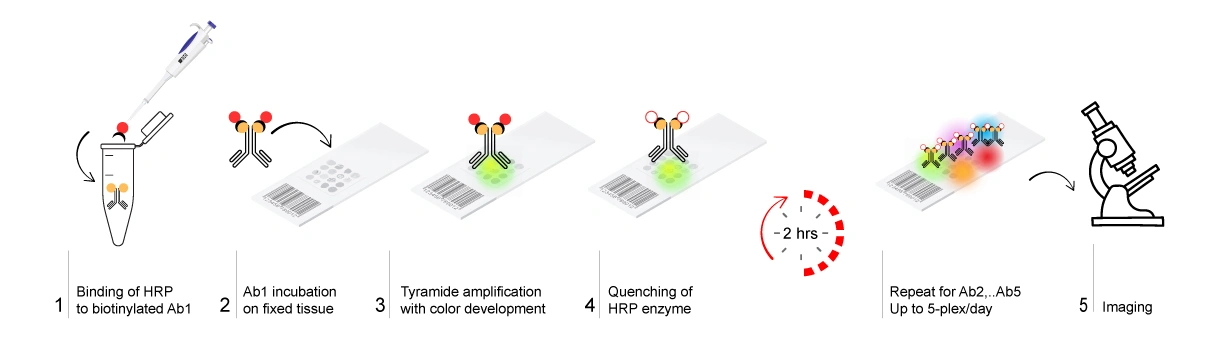
Utilize Tyramide Signal Amplification (TSA). This method generates an intensely bright and stable signal through covalent labeling.
The AtlasPlex Advantage: We utilize a powerful TSA method to create a permanent stain that won’t fade over time. This ensures high-contrast images with an excellent signal-to-noise ratio, even in challenging FFPE tissues.
Hurdle #3: Tissue Damage from Harsh Antibody Stripping
Iterative IHC workflows, where staining is done in cycles, typically require a harsh stripping step between rounds to remove previous antibodies. This process often involves chemicals or heat that can:
- Damage delicate tissue morphology.
- Mask antigens, preventing detection in later rounds.
- Lead to poor reproducibility and unreliable data.
The Solution:
Transition to rapid, gentle elution processes. By removing antibodies without destructive stripping, you preserve tissue integrity for every subsequent cycle.
The AtlasPlex Advantage: The AtlasPlex workflow is designed to be gentle on your precious samples. Our elution process preserves your antigens and tissue structure, ensuring reproducible results round after round.
Hurdle #4: The Multi-Day Marathon Workflow
Traditional iterative staining is a marathon, not a sprint. Long incubations and tedious manual steps mean a single 3- or 5-plex experiment can easily stretch across several days. This creates a major bottleneck in your research pipeline.
The Solution:
Engineering the workflow for maximum efficiency. By streamlining the protocol and using rapid elution, the entire multiplexing procedure can be compressed into a single workday.
The AtlasPlex Advantage: We’ve optimized our protocol so you can go from sample to data in hours, not days. This allows you to scale your research without being held back by the clock.
| Workflow Feature | Traditional Manual mIHC | AtlasPlex Solution |
|---|---|---|
| Turnaround Time | 2–4 Days | < 1 Day |
| Species Requirements | Must use different species | Species-independent |
| Signal Stability | High risk of fading | Permanent covalent stain |
| Tissue Preservation | High risk (Heat/Stripping) | High (Gentle Elution) |
Ready to build your next panel without compromise?
AtlasPlex is a ready-to-use multiplex IHC assay for iterative, high-throughput mIHC on FFPE tissue — up to 5 biomarkers a day.
Because the antibodies come pre-biotinylated, the assay is species-independent and needs no secondary antibodies, removing cross-reactivity concerns and most optimization work. Signal is amplified by the TSA tyramide system for strong, reproducible staining.
Build fully customizable panels from more than 12,000 Human Protein Atlas–validated targets, with no pre-set restrictions.
Stop letting technical limitations slow down your research.
By eliminating host species restrictions and reducing your workflow to a single day, AtlasPlex streamlines your path from sample to insight.