
Most methods for studying protein-protein interactions show you where two proteins meet. They don't show how much of each protein is not interacting. Without that number, an interaction signal is hard to interpret: a stronger signal can mean more binding, or simply more protein.
MolBoolean™, developed by Atlas Antibodies, detects both in the same sample: free protein A, free protein B, and the A–B complex, in fixed cells and tissue.
From PLA to MolBoolean
MolBoolean builds on the in situ proximity ligation assay (PLA), co-invented almost 20 years ago by Professor Ola Söderberg at Uppsala University.
Söderberg saw a way to extend PLA so it could also detect proteins that are not interacting. He published the method in Nature Communications in 2022 and brought it to Atlas Antibodies, which secured the rights in 2019 and launched the kit in 2023.

Photo: Prof. Ola Söderberg visiting Forskaren, the Atlas Antibodies headquarters in Stockholm, Sweden.
How it works
Researchers use their own primary antibodies: one mouse and one rabbit. The kit supplies everything else, and can be customized for most other species on request.
- Secondary antibody probes, conjugated to DNA, bind to the primary antibodies.
- The probes link to a shared DNA circle, which is tagged according to the probe that bound it.
- If the two proteins are close together (about 40 nm), the circle carries both tags. If not, it carries one.
- Rolling circle amplification boosts the signal about 1,000-fold, and fluorescent oligos reveal the tags.
The readout
One color means free protein A, the other color means free protein B, and both colors together mean the complex. Everything can be imaged and quantified on a standard fluorescence microscope.
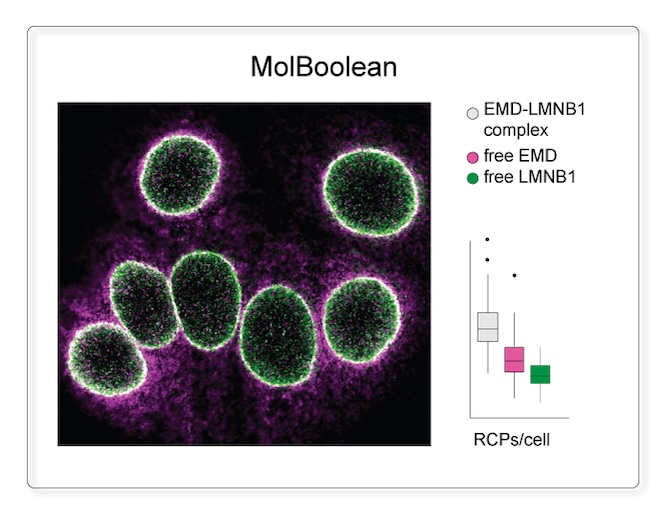
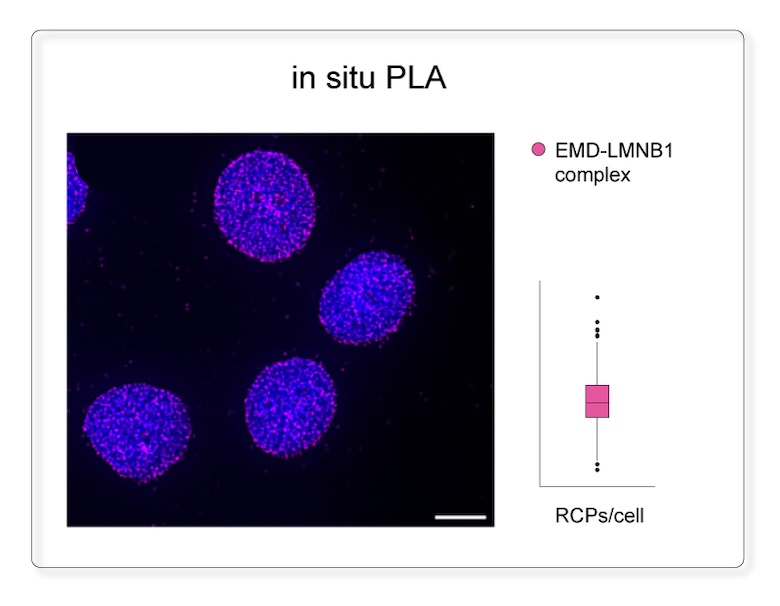
Figure 1: MolBoolean vs. PLA in MCF7 cells.
MolBoolean detects free EMD, free LMNB1, and the EMD–LMNB1 complex in the same cells while in situ PLA only detects the EMD–LMNB1 complex.
"The ability to measure both bound and free proteins allows researchers to normalize the number of protein-protein interactions to the total amount of target proteins in a sample," says Mikael Malmqvist, PhD, Principal Scientist at Atlas Antibodies. "This prevents a common misreading: a rise in interaction signal that actually comes from higher protein expression."

Photo: Mikael Malmqvist, PhD, Principal Scientist, Atlas Antibodies, Stockholm, Sweden.
In short
"MolBoolean is a cutting-edge technology developed in collaboration with leading scientists in the PLA field. This kit enables researchers to identify and measure protein-protein interactions in situ, in both fixed cells and tissue."
References
- Franco R, Lillo J, Griñán-Ferré C, Pallàs M, Rivas-Santisteban R. Quantifying heteromer partitioning reveals inflammation-dependent redistribution of microglial adenosine A2A and cannabinoid CB2 receptors. Glia. 2026 Sep;74(9):e70200. doi:10.1002/glia.70200. PMID: 42482393; PMCID: PMC13389093.
- Rivas-Santisteban R, et al. GPR88 impairs the signaling of kappa opioid receptors in a heterologous system and in primary striatal neurons. Neuropharmacology. 2024 Nov 27:110242. doi:10.1016/j.neuropharm.2024.110242. PMID: 39613254.
- Malmqvist M, et al. Quantifying dopamine D2 and adenosine A2A receptor interactions in rat brain using MolBoolean™ technology. Society for Neuroscience (SfN) annual meeting, 2024. Poster.
- Kotliar IB, et al. Multiplexed mapping of the interactome of GPCRs with receptor activity-modifying proteins. Sci Adv. 2024 Aug 2;10(31):eado9959. PMID: 39083597; PMCID: PMC11290489.
- Rivas-Santisteban R, et al. Boolean analysis shows a high proportion of dopamine D2 receptors interacting with adenosine A2A receptors in striatal medium spiny neurons of mouse and non-human primate models of Parkinson's disease. Neurobiol Dis. 2023 Nov;188:106341. doi:10.1016/j.nbd.2023.106341. PMID: 37918757.
- Raykova D, et al. A method for Boolean analysis of protein interactions at a molecular level. Nat Commun. 2022 Aug 13;13(1):4755. doi:10.1038/s41467-022-32395-w.