
Cart 0


Stop Guessing. Start Publishing. 

Antibodies Validated by the Human Protein Atlas


Reproducible results, backed by open data.

Our antibodies were developed within the Human Protein Atlas (HPA) project and validated with standardized protocols for immunohistochemistry (IHC), Western blot (WB) and immunocytochemistry/immunofluorescence (ICC-IF). More than 750 have also been independently benchmarked for ChIP-Exo-Seq at Cornell University.

We've spent 20 years building validation on one principle: specificity should be demonstrated, documented and open to inspection.

Each antibody is backed by extensive data: tissue expression profiles, staining images and validation results, all freely available on proteinatlas.org. When you choose our antibodies, you get more than a reagent. You get access to a widely used reference for protein expression in human tissues and cells.
 

BROWSE PRODUCTS

You focus on the research.  We’ll handle the validation.


How do we ensure antibody specificity and reproducibility?

At Atlas Antibodies, ensuring the highest standards for antibody characterization, validation, and reproducibility has always been our top priority. Our rigorous validation process guarantees that every antibody we produce is highly specific and delivers consistent performance in every application.

In this video, we detail our comprehensive approach to antibody validation and demonstrate the extensive work we conduct to ensure reproducibility, particularly in immunohistochemistry (IHC). Learn how our commitment to quality supports researchers with reliable tools for their studies.


Advancing Antibody Validation: Insights from Prof. Mathias Uhlén

In this video, Prof. Mathias Uhlén, Director of the Human Protein Atlas, introduces the proposal for antibody validation published in Nature Methods. He emphasizes the importance of application- and context-specific antibody validation to ensure reliable research outcomes. Prof. Uhlén also highlights the unique advantages of polyclonal antibodies in the context of the Human Protein Atlas, particularly their utility in exploring complex protein interactions and ensuring comprehensive target coverage.


Setting the Standard: Antibodies You Can Trust


Application-Ready Results

Our antibodies are extensively validated for your specific applications — including IHC (on 44 human tissues), Western blot, immunofluorescence and ChIP.

✔ Multi-application validation data ensures you get the performance you expect — right out of the box.

Unrivaled Specificity

Eliminate the guesswork.
Enhanced validation using PrEST antigens delivers high specificity and minimal off-target effects, resulting in cleaner, more reliable data.

✔ See the difference with side-by-side images comparisons.


Consistent Performance, Batch After Batch

Stop worrying about lot-to-lot variability.
Our ISO 9001-certified production process ensures every batch meets the same high standards — saving you time on re-validation and troubleshooting.

✔ Quality you can trust, every time.

Total Transparency

Know exactly what you're working with.
We provide free, full access to all validation data, including high-resolution IHC images and experimental details.

✔ Confidence comes from complete visibility.

Get Reproducible Data. Faster.  

  • Antigen Design: Specificity from the Start

    Each antibody is developed against a recombinant human Protein Epitope Signature Tag (PrEST), typically 50–150 amino acids in length.
    These PrEST sequences are carefully selected to have minimal sequence similarity to other human proteins, significantly reducing the risk of cross-reactivity.

  • Functional Validation in Key Applications

    Our Triple A Polyclonals and PrecisA Monoclonals undergo functional validation in the most common antibody-based assays, including:

    • Immunohistochemistry (IHC)
    • Immunocytochemistry–Immunofluorescence (ICC–IF)
    • Western blot (WB)
    • Chromatin Immunoprecipitation ChIP


    For IHC, each antibody is evaluated in a broad panel of tissues, including 44 normal human tissues and the 20 most common cancer types. Performance is documented with over 500 high-resolution staining images per antibody, reviewed and annotated by expert researchers and pathologists. These images are available via the Human Protein Atlas.

  • Antibody Approval and Supporting Data

    Antibody specificity is further assessed through a combination of literature review, bioinformatics analysis, and comparison to RNA sequencing data to ensure biological relevance.

  • Commitment to Transparency

    All validation data, including images and experimental conditions, are freely available on the Atlas Antibodies and Human Protein Atlas websites.
    We also provide the exact immunogen sequence used for antibody generation, giving you complete insight into how each reagent was developed.

  • Validation vs. Reproducibility: Understanding the Difference

    While both validation and reproducibility are essential for antibody quality, they address distinct aspects of performance:

    Validation ensures that an antibody specifically binds to its intended target. Before any antibody is added to our catalog, it undergoes extensive validation. All validation data are documented and included on the antibody’s product data sheet.
    Reproducibility refers to the ability of an antibody to perform equally across different production lots. It ensures that a new batch behaves in the same way as the previous one, across all validated applications.

  • Our Approach to Reproducibility

    To guarantee reproducibility, each new antibody lot is tested against a reference lot. The comparison includes performance in all relevant applications (e.g., IHC, WB, ICC–IF), ensuring that the specificity and functionality remain consistent.

    This process allows us to maintain lot-to-lot consistency and provide researchers with reliable antibodies they can trust across long-term projects.

  • Example of reproducibility in IHC

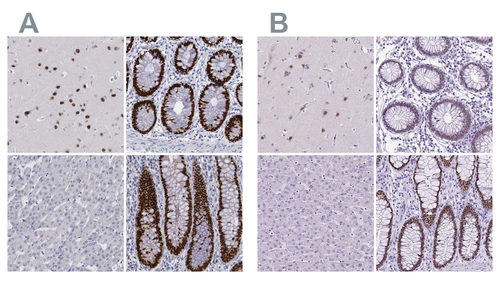
    The standard test set-up for quality control of an antibody for the IHC application at Atlas Antibodies consists of a tissue microarray of more than 20 different samples of both normal and cancer tissues. The new lot of the antibody is tested and compared to the reference lot on consecutive sections from the tissue microarray.

    As the original manufacturer of all our products, we have full control of both the validation and reproducibility. You can trust that our antibodies are specific and perform consistently each time you use them.

    The image show examples from the quality control of antibody Anti-SATB2 (HPA001042) where a new lot is tested against its reference lot: IHC staining of human cerebral cortex, colon, liver and rectum using Anti-SATB2 antibody HPA001042 (A) shows similar protein distribution across tissues to independent Anti-SATB2 antibody HPA029543 (B).

 
Enhanced Validation: Beyond Basic Validation
The Atlas Antibodies Difference


READ MORE


Atlas Antibodies:

ISO certified according to ISO9001


Atlas Antibodies are ISO certified according to ISO9001 showing that our quality management system is up to that standard.

ISO 9001 is the internationally recognized standard for a quality management system (QMS) and organizations adhere to the standard to organize and continually improve business processes and efficiency.

This accreditation demonstrates Atlas Antibodies’ ongoing commitment to quality by satisfying customer requirements and industry specifications through an effective quality management system.