
MolBoolean reveals novel insights into D2-A2A receptor interactions in Parkinson's disease
Rivas-Santisteban R, et al. "Boolean analysis shows a high proportion of dopamine D2 receptors interacting with adenosine A2A receptors in striatal medium spiny neurons of mouse and non-human primate models of Parkinson's disease." Neurobiol Dis. 2023 Nov;188:106341. doi: 10.1016/j.nbd.2023.106341.
In the study by Rivas-Santisteban et al. (2023), the authors utilize MolBoolean technology (from Atlas Antibodies, Sweden) to investigate D2-A2A receptor interactions in Parkinson's disease.
The research includes data from both mouse and non-human primate models, providing a comparative perspective that enhances the relevance and generalisability of the findings across different species.
They demonstrate a high prevalence of dopamine D2 receptors interacting with adenosine A2A receptors in striatal medium spiny neurons of both mouse and non-human primate models.
MolBoolean™ provided quantitative data on the proportion of individual receptors and receptor complexes in multiple experimental conditions such as: heterologous HEK-293 cells, primary striatal neurons, rat 6-OHDA-PD model, Macaca MPTP-lesioned PD model, highlighting the prevalence of A2AR-D2R heteromers in primary striatal neurons.
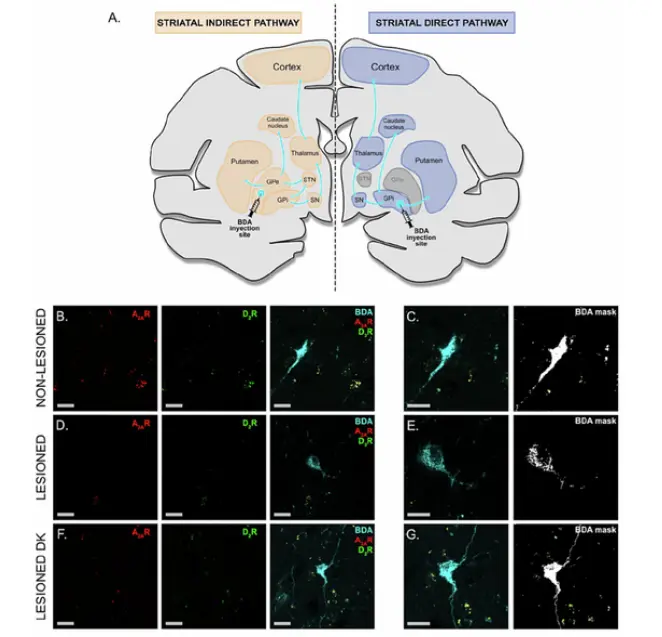
This detailed analysis highlights the significant interplay between these receptors, providing insights into the neurochemical changes associated with Parkinson's disease and advancing the understanding of receptor dynamics in disease pathology.
The application of MolBoolean technology to examine receptor interactions represents a novel methodological approach. By leveraging this technique, the study offers a more nuanced view of how these receptors interact in the context of Parkinson's disease, which may not have been possible with traditional methods.
Identifying the high proportion of receptor interactions in Parkinson’s disease models could lead to new insights into the underlying mechanisms of the disease. This may help in developing targeted therapeutic strategies aimed at modulating these interactions to alleviate symptoms or slow disease progression.