
This morning in Stockholm, the Nobel Assembly awarded the 2025 Nobel Prize in Physiology or Medicine for the groundbreaking discoveries that identified the genetic basis of a rare and devastating autoimmune disease, which ultimately unlocked the master control switch of the entire immune system.
The prize honors the identification of mutations in the FOXP3 gene as the cause of IPEX syndrome, a discovery that has fundamentally reshaped our understanding of immune tolerance and opened new avenues for treating autoimmunity and cancer.
First described in the seminal 2001 Nature Genetics paper, "The immune dysregulation, polyendocrinopathy, enteropathy, X-linked syndrome (IPEX) is caused by mutations of FOXP3 " (Bennett CL et al., Nat Genet. 2001 Jan;27(1):20-1), this work connected a single gene to the body's catastrophic failure to regulate its own immune response. This discovery didn't just explain a rare disease; it identified FOXP3 as the essential transcription factor that defines the "peacekeepers" of our body: regulatory T cells (Tregs).
What is IPEX Syndrome and What Does FOXP3 Do?
IPEX syndrome is a rare genetic disorder where the immune system attacks the body's own tissues, leading to severe autoimmune conditions. The 2025 Nobel Prize-winning research proved that a non-functional FOXP3 protein is the direct cause.
This established that the function of FOXP3 is absolutely essential for:
- Establishing Immune Tolerance: FOXP3 is the master regulator that programs Tregs to distinguish between "self" and "non-self." Without it, the immune system runs rampant.
- Controlling Inflammation: By orchestrating Treg activity, FOXP3 tempers inflammatory responses throughout the body, maintaining the delicate balance known as homeostasis.
- Informing Cancer Immunotherapy: The very mechanisms of immune suppression controlled by FOXp3 are the same ones that cancers exploit to protect themselves from attack. Understanding this is critical for developing more effective cancer treatments.
The identification of FOXP3 was a watershed moment, moving immunology from observing immune regulation to understanding its core genetic blueprint.
Powering Nobel-Worthy Research: Validated FOXP3 Antibodies
Studying a nuclear transcription factor at the center of a Nobel Prize-winning discovery requires absolute precision. Researchers investigating autoimmune disease, inflammation, and immuno-oncology need to know, with certainty, that they are accurately identifying FOXP3-expressing Tregs in their samples.
At Atlas Antibodies, our commitment to Enhanced Validation ensures that our antibodies provide the specificity and reliability required for this level of research. We provide the essential tools to empower scientists to build upon this year's Nobel-recognized work.
Explore Our Portfolio for Your Research:
- PrecisA Monoclonal Anti-FOXP3 Antibody (AMAB92051): For researchers who demand the highest level of specificity and lot-to-lot consistency, our monoclonal antibody is the gold standard. It is extensively validated for Immunohistochemistry (IHC), Immunocytochemistry (ICC), and Western Blot (WB).
- Triple A Polyclonal Anti-FOXP3 Antibodies (HPA045943 & HPA069372): Our robust polyclonal antibodies offer strong, reliable detection of the FOXP3 protein and are validated across multiple applications, providing excellent tools for initial discovery and screening.
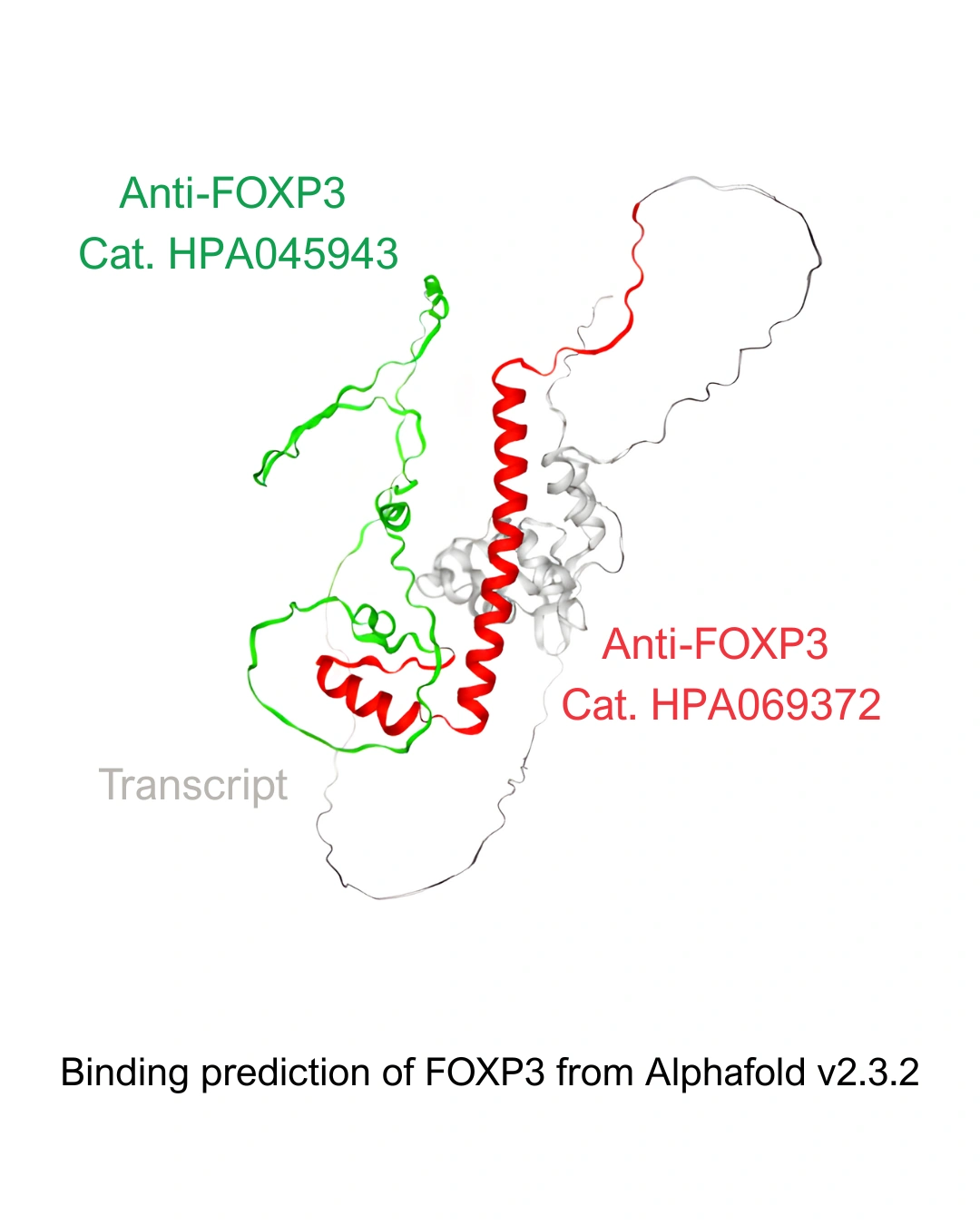
By using these highly specific antibodies, you can accurately identify and quantify Tregs, accelerate the development of next-generation therapies for autoimmune diseases, and deepen your understanding of the tumor microenvironment.
Questions & Answers
- What is the 2025 Nobel Prize in Medicine for? The 2025 Nobel Prize in Physiology or Medicine was awarded to Mary E. Brunkow (Institute for Systems Biology, Seattle, USA), Fred Ramsdell (Sonoma Biotherapeutics, San Francisco, USA) and Shimon Sakaguchi (Osaka University,Osaka, Japan) for the discovery that mutations in the FOXP3 gene are the cause of the severe autoimmune disorder IPEX syndrome. This work identified FOXP3 as the master regulator of the immune system's T-regulatory cells.
- What is FOXP3 a marker for? FOXP3 is the most widely accepted and specific protein marker for regulatory T cells (Tregs). Its expression is essential for their function and is used to identify this crucial cell lineage in tissue and cell samples.
- Can I use Atlas Antibodies' FOXP3 antibodies for IHC? Yes, all our listed FOXP3 antibodies, including our PrecisA Monoclonal (AMAB92051), are extensively validated for immunohistochemistry (IHC), making them ideal for visualizing the immune landscape in FFPE tissues.